

Core Supplements
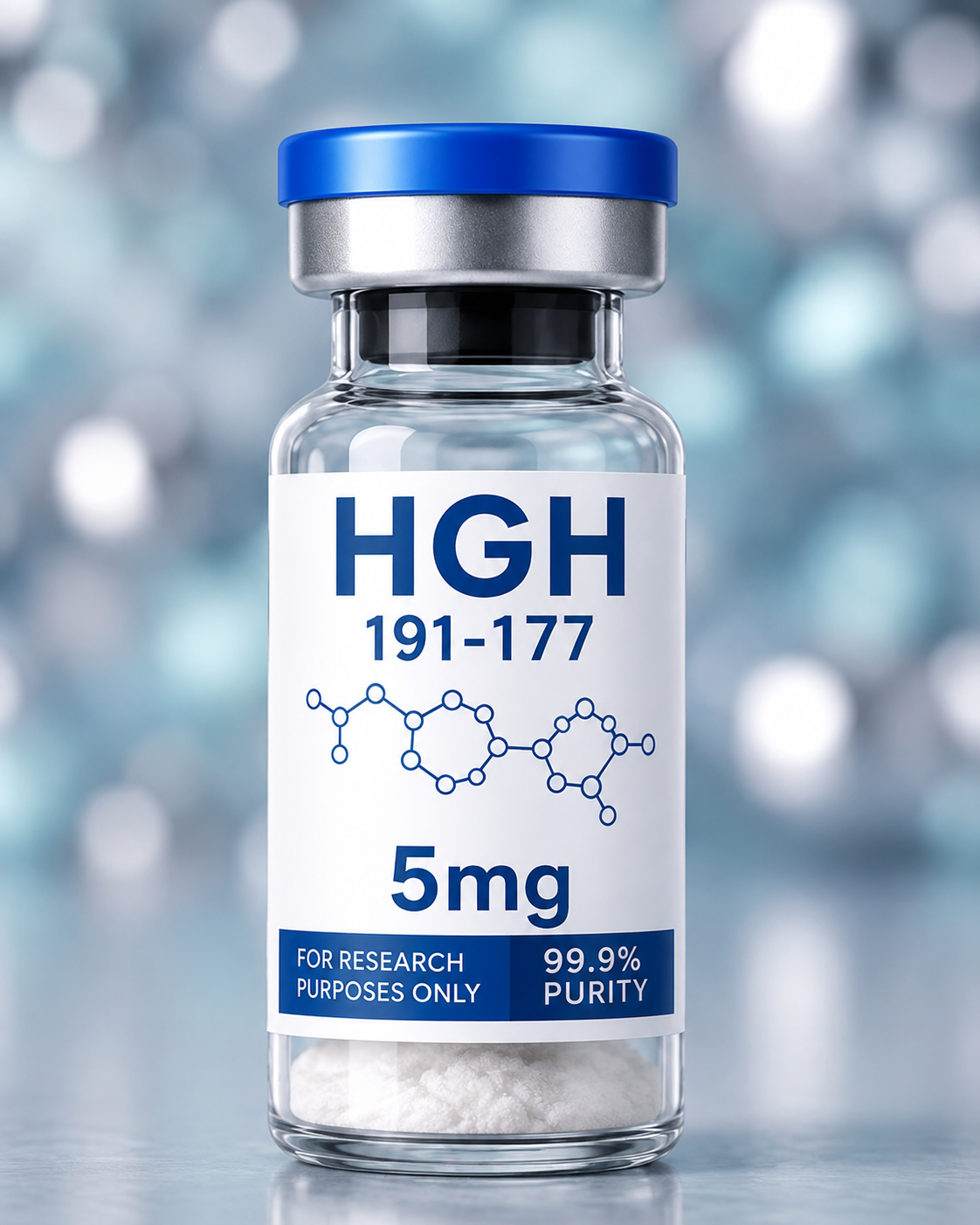
HGH 191-177
HGH 191-177
Couldn't load pickup availability
Product Specifications
| Specification | Detail |
|---|---|
| Product Class / Category | Growth Hormone Peptide Fragment |
| Research Identifier | HGH Fragment 177‑191 (synonym HGH 191‑177), CAS 1262237‑79‑5 |
| HPLC Purity Threshold | >99% (routine batch-specific HPLC at 214 nm) |
| Target Receptors / Chemical Pathways | Growth Hormone Receptor (GHR) extracellular domain – selective in‑vitro interaction at site‑2 binding pocket; lipolytic signaling observed in 3T3‑L1 adipocyte research models |
| Regulatory Status | For In‑Vitro & Laboratory Analytical Research Only. Not for human, veterinary, diagnostic, or therapeutic use. |
Research Overview & Mechanism of Action
HGH 191‑177 is a synthetic 15‑amino acid C‑terminal fragment of human somatotropin. The sequence spans residues 177 through 191 — hence the dual naming — and carries an intramolecular disulfide bridge between Cys‑182 and Cys‑189. Its monoisotopic mass weighs 1815.1 Da. The primary structure reads Leu‑Arg‑Ile‑Val‑Gln‑Cys‑Arg‑Ser‑Val‑Glu‑Gly‑Ser‑Cys‑Gly‑Phe.
This fragment has zero growth‑promoting activity. That’s well documented. Instead, it binds the growth hormone receptor through the site‑2 contact surface without triggering the conformational dimerization required for full‑length signalling. In multiple in‑vitro adipocyte models, the peptide shifts the GHR into a partially activated state that uncouples lipolytic readouts from IGF‑1 transcription. Researchers therefore use HGH 191‑177 as a probe to dissect biased signalling downstream of the GHR. Receptor selectivity, molar ratio‑dependent binding curves, and long incubation‑time stability are the aspects that matter most in the lab.
Analytical control is built into every lot. We rely on reverse‑phase HPLC with a C18 column and electrospray ionisation mass spectrometry. The chromatogram routinely lands at >99% area under the curve. The lyophilized cake often looks cracked or slightly displaced. That’s normal. Rapid freeze‑drying and transport vibration cause the dried matrix to fracture without altering peptide integrity.
Handling, Reconstitution & Storage Protocol
Keep the lyophilized vial at –20 °C for long‑term storage. Room‑temperature transit for a few days causes no measurable degradation. Let the sealed vial sit at ambient lab temperature for at least 15 minutes before you crack the cap. Condensation invites moisture‑driven aggregation — skip that step and you risk a cloudy reconstitution.
Reconstitution protocol for analytical concentration:
- Use sterile bacteriostatic water (0.9% benzyl alcohol) or phosphate‑buffered saline, pH 7.4.
- Draw the desired volume into a low‑dead‑volume syringe, then inject gently down the glass wall.
-
Target a stock concentration of 1–2 mg/mL. The peptide dissolves readily; gentle swirling is enough. Vortexing or foaming shears the peptide backbone.
- For cell‑based assays where plastic‑ware adsorption is a concern, supplement the diluent with 0.1% molecular‑biology‑grade bovine serum albumin as a carrier protein. This step preserves free‑peptide molar ratio at sub‑micromolar working concentrations.
Post‑reconstitution shelf‑life: Store the solution at 2–8 °C and use within 2‑3 weeks for consistent in‑vitro results. Aliquot single‑use volumes and avoid freeze‑thaw cycling. A single freeze‑thaw cycle drops bioactive signal by roughly 15% in our internal stability trials — plan your aliquots accordingly.
Scientific References & External Citations
- PubMed: HGH Fragment 177‑191 Research – Curated studies mapping the lipolytic domain of human growth hormone.
-
PubChem Compound: HGH Fragment 177‑191 – Structural identifiers, molecular weight, and chemical classification.
Frequently Asked Research Questions
What is the exact amino acid sequence and molecular weight of HGH 191‑177?
The peptide corresponds to HGH residues 177‑191 with the sequence H‑Leu‑Arg‑Ile‑Val‑Gln‑Cys‑Arg‑Ser‑Val‑Glu‑Gly‑Ser‑Cys‑Gly‑Phe‑OH. The oxidised form, containing a Cys‑Cys intramolecular disulfide, has a monoisotopic mass of 1815.1 g/mol. Both reduced and oxidised masses are confirmed on every batch CoA via ESI‑MS.How should I reconstitute HGH 191‑177 for cell‑culture experiments?
Aim for a stock analytical concentration of 1‑2 mg/mL in sterile bacteriostatic water or PBS. Add 0.1% BSA to the final diluent if your protocol uses low‑micromolar working solutions on polystyrene plates. Swirl gently; mechanical agitation or prolonged vortexing degrades peptide integrity. Always allow the lyophilized cake to equilibrate to room temperature before adding the diluent.Is a batch‑specific Certificate of Analysis provided?
Absolutely. Each 5 mg research vial leaves our laboratory with a printed and digitally archived CoA containing the HPLC purity reading, retention time, ESI‑MS spectrum, and observed peptide mass. The lot number printed on the vial matches the CoA one‑to‑one.Can this peptide be used in human diagnostics or therapeutic research?
No. HGH 191‑177 is manufactured for in‑vitro analytical research only. It is not intended for human or veterinary administration, clinical diagnostics, or therapeutic use. All purchase orders are screened to ensure compliance with this research‑use‑only restriction.
Share
Certificate of Analysis (COA)
A batch-specific Certificate of Analysis is generated for every lot. Customers may request the COA for their batch by emailing our support address with their order number.
Important regulatory notice — please read before ordering
- This product is not a drug, not a medicine, not a food, not a cosmetic, and not a nutritional supplement. It is not approved for any such use by the Central Drugs Standard Control Organisation (CDSCO), the Food Safety and Standards Authority of India (FSSAI), or any other Indian or foreign regulator.
- This product is not intended, labelled, packaged, or sold for human or veterinary consumption, injection, inhalation, ingestion, topical application, or any in-vivo use whatsoever.
- This product is supplied strictly for use by qualified researchers in an appropriate in-vitro laboratory setting, in compliance with all applicable Indian laws including the Drugs and Cosmetics Act 1940, the Food Safety and Standards Act 2006, and the Drugs and Magic Remedies (Objectionable Advertisements) Act 1954.
- By placing an order, the purchaser affirms that (i) they are 18 years of age or older; (ii) they are acquiring the material solely for bona-fide in-vitro research and analytical testing; (iii) they will not consume, inject, apply, administer, or otherwise use the product on themselves, any other person, or any animal; (iv) they will not resell or redistribute the product for human or veterinary use; and (v) they will comply with all applicable laws.
- If you are unable to give these affirmations, please do not order. We reserve the right to cancel and refund any order that we believe is intended for any use other than in-vitro laboratory research.
Note: The sticker design on the product may vary from the image shown.
No claims are made, directly or indirectly, as to the suitability of this material to diagnose, treat, cure, prevent, or mitigate any disease or condition in humans or animals.
FREQUENTLY ASKED QUESTIONS
Where can I buy research peptides in India?
Corepeptides offers premium-grade research compounds with secure shipping across India. Products are supplied strictly for in-vitro laboratory and analytical research use only.
Do you ship peptides across India?
Yes, we provide secure and discreet shipping across India with estimated delivery timelines of 15–20 working days.
What is the purity standard of this peptide?
Our products are sourced with a focus on research-grade purity, consistency, and quality standards.
How do I know this is a genuine peptide product in India?
Every product is carefully sourced with quality control standards and secure packaging to ensure reliability and authenticity.