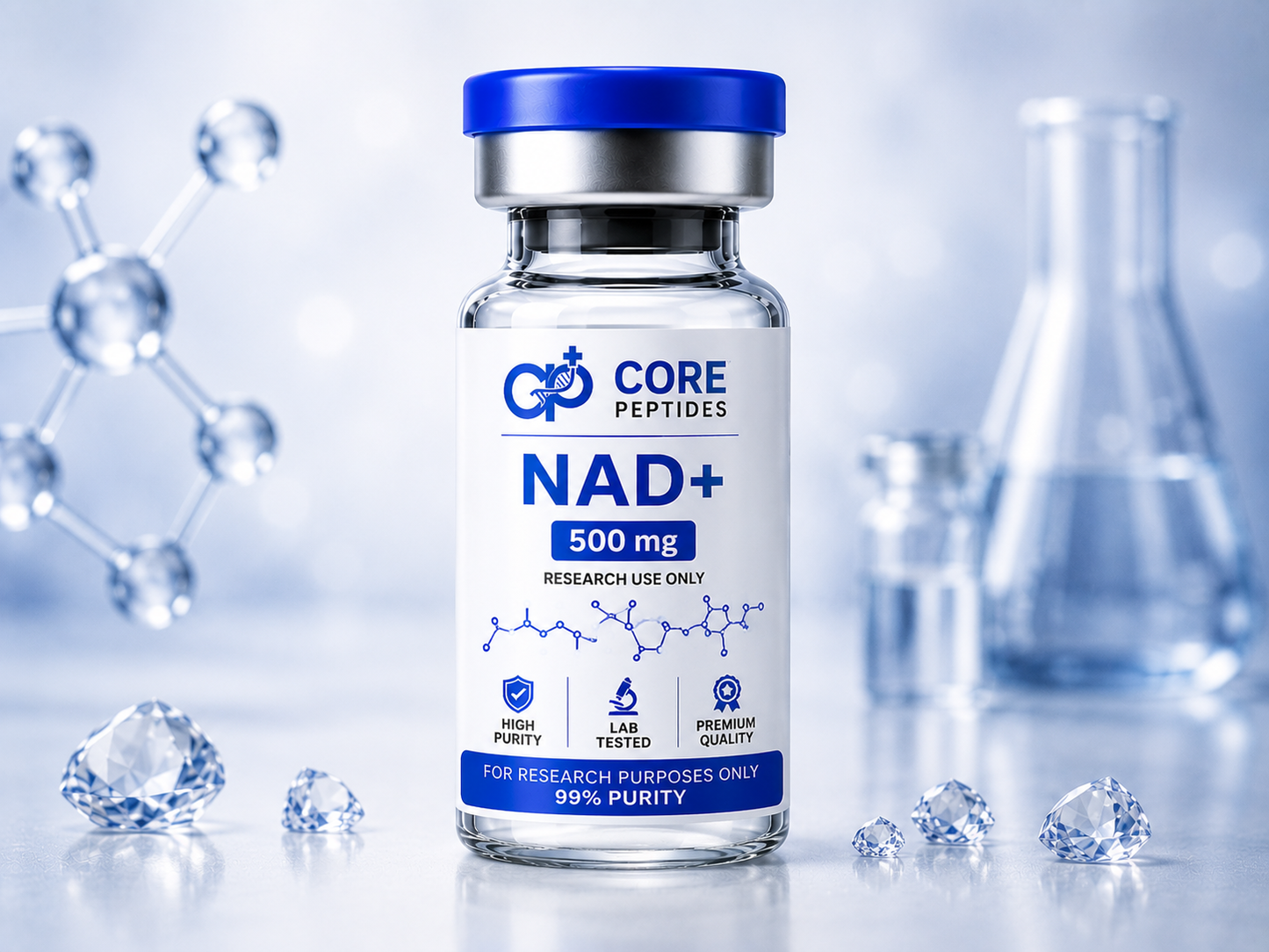
CAS 53-84-9. >99% purity by RP‑HPLC at 260 nm. 1000 mg of lyophilized, oxidized β‑Nicotinamide Adenine Dinucleotide packed under argon in an amber glass vial. CorePeptides India delivers every gram with a batch‑locked Certificate of Analysis.
Product Specifications
| Specification | Detail |
|---|---|
| Product Class / Category | Pyridine Nucleotide Coenzyme (Oxidised Form) |
| Research Identifier | β‑Nicotinamide Adenine Dinucleotide (NAD⁺, NAD, Diphosphopyridine Nucleotide), CAS 53‑84‑9 |
| Supplier / Brand | CorePeptides India |
| HPLC Purity Threshold | >99% (RP‑HPLC, C18, UV‑Vis detection at 260 nm, batch‑specific) |
| Target Receptors / Chemical Pathways | Redox cofactor (hydride acceptor in glycolysis, TCA cycle, oxidative phosphorylation); substrate for sirtuin deacetylases (SIRT1‑7), poly‑ADP‑ribose polymerases (PARPs), CD38/CD157 NADases; in‑vitro modulator of ADP‑ribosylation, cellular NAD⁺/NADH ratio, and mitochondrial respiration |
| Regulatory Status | For In‑Vitro & Laboratory Analytical Research Only. Not for human, veterinary, diagnostic, or therapeutic use. |
Research Overview & Mechanism of Action
NAD⁺ is a dinucleotide built from nicotinamide mononucleotide (NMN) and adenosine monophosphate (AMP), bridged by a pyrophosphate bond. Its oxidised nicotinamide ring absorbs sharply at 260 nm with an extinction coefficient of 17.8 × 10³ M⁻¹cm⁻¹ - a bench‑mark constant every researcher should know. Molecular weight is 663.4 g/mol. A 1000 mg vial supplies enough material for months of repeatable analytical concentration‑response work without the noise of inter‑lot variability.
Inside a cuvette or a well plate, NAD⁺ accepts a hydride ion and a proton to form NADH. The reduced form gains a distinct absorbance at 340 nm. That spectral shift is the practical readout for countless dehydrogenase‑coupled enzyme assays. Beyond redox, this molecule is an obligatory substrate for NAD⁺‑consuming enzymes - sirtuins strip the nicotinamide moiety to generate O‑acetyl‑ADP‑ribose during deacetylation, while PARPs cleave the glycosidic bond entirely to build poly‑ADP‑ribose chains. Researchers running in‑vitro SIRT1 activity assays or PARP‑1 auto‑modification gels rely on a single key variable: the molar ratio of NAD⁺ to enzyme in the reaction mix. A 1000 mg stock lets you standardise that ratio across experimental blocks without exhausting supply mid‑study. The lyophilized powder often looks a little clumped or electrostatically stuck to the glass. That’s harmless - it’s just the light, fluffy nature of bulk‑dried dinucleotide.
Handling, Reconstitution & Storage Protocol
Lyophilized NAD⁺ is hygroscopic. Keep the sealed amber vial at –20 °C with desiccant. Short ambient‑temperature transit - under a week - does not trigger detectable degradation in our stability series. Upon arrival, let the unopened vial sit at room temperature for 30 minutes. A one‑gram dry mass holds thermal inertia; opening it cold invites condensation and rapid moisture uptake that can accelerate hydrolysis of the pyrophosphate bond.
Reconstitution for analytical research:
- Use ultrapure, degassed water (≥18.2 MΩ·cm) or sterile phosphate‑buffered saline, pH 7.4.
- For a 100 mM stock, add 15.07 mL of diluent to the 1000 mg powder. Inject the solvent slowly, aiming for the glass wall, then swirl. Don’t vortex. The solution should turn clear within a minute.
- NAD⁺ is acidic in solution; the free acid form will drop unbuffered water to pH ~4. If your enzyme assay demands physiological pH, use PBS or adjust with a small volume of sterile 1M NaOH while monitoring pH - the pyrophosphate linkage is labile above pH 8, so work carefully.
- For sub‑millimolar working concentrations in cell‑culture or enzymatic assays, prepare single‑use aliquots immediately. NAD⁺ in solution undergoes slow non‑enzymatic hydrolysis at room temperature. Freeze aliquots at –80 °C. A single freeze‑thaw cycle can cut enzymatic signal by about 5–10% -tolerable for some screens, but avoid it for rigorous kinetic work.
Scientific References & External Citations
- PubChem Compound: NAD⁺ (CID 5893) - Full chemical identifiers, spectral data, and structural files.
- PubMed: Sirtuin & NAD⁺ Research - Peer‑reviewed in‑vitro enzyme studies mapping NAD⁺‑dependent deacetylase activity.
- PubMed: NAD⁺ in Cellular Bioenergetics - Research protocols using NAD⁺/NADH ratio measurements in isolated mitochondria and cell lysates.
Frequently Asked Research Questions
What is the CAS number and molecular weight of NAD⁺?
The oxidised form, β‑Nicotinamide Adenine Dinucleotide, carries CAS number 53‑84‑9 and has a molecular weight of 663.4 g/mol. Its characteristic UV absorbance peak at 260 nm (ε = 17.8 × 10³ M⁻¹cm⁻¹) is used to verify concentration and purity in every CorePeptides India batch.
How should I reconstitute the 1000 mg vial for sirtuin or PARP enzyme assays?
Dissolve the powder in sterile PBS or ultrapure water to a stock analytical concentration of 100 mM (15.07 mL for the full gram). Let the vial warm completely before opening to avoid moisture condensation. Swirl gently - vortexing is unnecessary. Adjust pH carefully if using water, and aliquot single‑use volumes for –80 °C storage to preserve substrate integrity.
Is a batch‑specific Certificate of Analysis provided by CorePeptides India?
Yes. Every 1000 mg vial ships with a printed and digitally archived COA showing the RP‑HPLC purity, retention time, UV‑Vis spectrum, and mass confirmation. The lot number on the vial links directly to that COA.
Can NAD⁺ be used in human clinical or therapeutic research?
No. CorePeptides India supplies NAD⁺ exclusively for in‑vitro laboratory research peptides. It is not manufactured for, nor authorised for, human or veterinary administration, diagnostic procedures, or clinical therapeutic development. All purchase orders are screened to uphold this restriction.