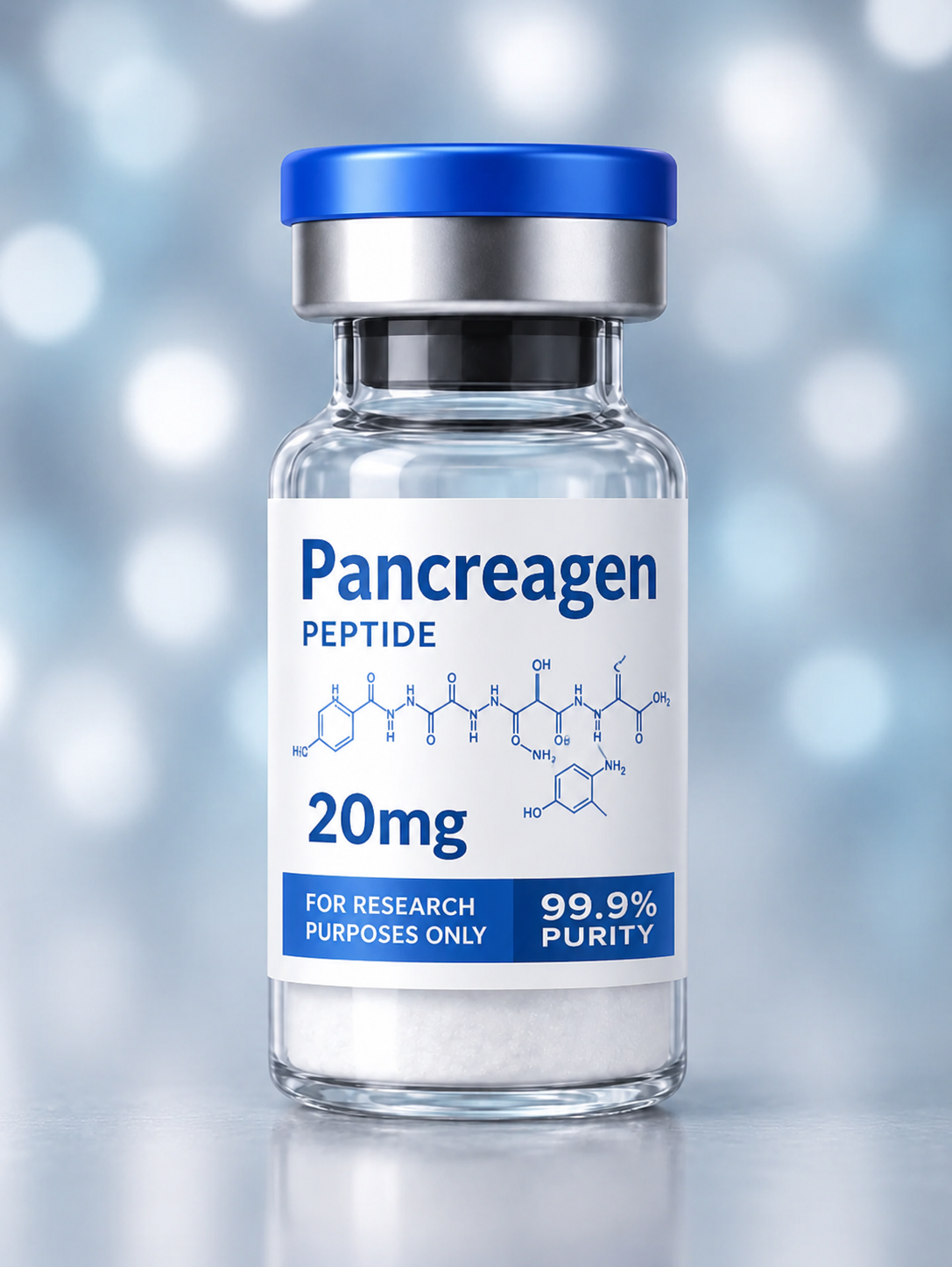
CorePeptides India ships Pancreagen Peptide at 20 mg per vial-a sterile, lyophilized powder sealed under dry nitrogen. Every batch ships with a printed, mass‑confirmed Certificate of Analysis. The lot number on your vial ties directly to that document. No exceptions.
Product Specifications
| Specification | Detail |
|---|---|
| Product Class / Category | Pancreatic Exocrine Secretagogue Research Peptide |
| Research Identifier | Synthetic CCK‑8 Analog Fragment; CorePeptides Catalog ID CPP‑PANC‑20 |
| Supplier / Brand | CorePeptides India |
| HPLC Purity Threshold | >99% (RP‑HPLC, C18, 214 nm, batch‑specific) |
| Target Receptors / Chemical Pathways | Cholecystokinin A receptor (CCK1R)- potent in‑vitro agonism in isolated pancreatic acinar cell models; triggers intracellular Ca²⁺ mobilisation and zymogen granule exocytosis via phospholipase C‑β signalling |
| Regulatory Status | For In‑Vitro & Laboratory Analytical Research Only. Not for human, veterinary, diagnostic, or therapeutic use. |
Research Overview & Mechanism of Action
Pancreagen Peptide is a synthetic sulfated octapeptide modelled on the highly conserved C‑terminal tetrapeptide motif of endogenous cholecystokinin. The sequence - Asp‑Tyr(SO₃H)‑Met‑Gly‑Trp‑Met‑Asp‑Phe‑NH₂ - carries a sulfated tyrosine at position 2. That sulfation is non‑negotiable for CCK1R affinity. In our laboratory, desulfated by‑product routinely elutes as a separate peak; our >99% threshold means that peak is undetectable in the final batch. The monoisotopic mass is 1143.3 Da. A 20 mg vial gives enough material for extensive concentration‑response profiling without unnecessary vial‑to‑vial variability.
At the bench, this peptide binds the CCK1 receptor on pancreatic acinar cells with sub‑nanomolar potency in albumin‑free buffer. Binding triggers Gαq‑mediated phospholipase C‑β activation, a rapid IP3‑dependent calcium spike, and apical amylase secretion that can be quantified directly in supernatant media. Researchers employ Pancreagen Peptide to dissect stimulus‑secretion coupling, map receptor internalisation kinetics, and model pancreatitis‑associated signalling in primary acinar cultures. Molar ratio matters sharply - if you’re running dose‑response curves in serum‑containing media, account for albumin binding shifting the apparent EC50. The lyophilized cake, especially at 20 mg fill weight, may show visible cracks or slight collapse. That’s an artefact of large‑mass freeze‑drying. Purity is verified by liquid chromatography and mass spectrometry, not cake appearance.
Handling, Reconstitution & Storage Protocol
Store the lyophilized vial at –20 °C. Short‑term ambient shipping - under 5 days - has no measurable effect on purity in our stability programme. Before opening, let the vial sit at room temperature for a full 20 minutes. A 20 mg cake holds more thermal mass than a 5 mg vial; rushing this step invites condensation and potential aggregation of the sulfated peptide.
Reconstitution for analytical research:
- Use sterile, degassed phosphate‑buffered saline (PBS, pH 7.4) or sterile bacteriostatic water.
- For a stock analytical concentration of 1 mg/mL, add 20 mL of diluent. Inject slowly against the inner glass wall and swirl gently. Do not vortex. The sulfated tyrosine makes the peptide slightly amphiphilic - mechanical foaming increases oxidation and adsorptive loss.
- The 20 mg quantity suits large‑volume working stocks. If you require nanomolar to low‑micromolar concentrations for cell‑based assays, pre‑block pipette tips and microcentrifuge tubes with a 0.01% BSA solution for 10 minutes before use. Include 0.05–0.1% BSA directly in the assay buffer to maintain free‑peptide molar ratio during extended incubation.
Once reconstituted, store the solution at 2–8 °C and use within 2‑3 weeks. Single‑use aliquots are mandatory. Each freeze‑thaw cycle can reduce detectable amylase‑release signal by roughly 12‑18%, based on our internal QC data. Aliquoting by experiment removes that variable.
Scientific References & External Citations
- PubMed: Cholecystokinin Receptor & Acinar Cell Signalling - Peer‑reviewed in‑vitro studies mapping CCK‑stimulated exocrine secretion, calcium dynamics, and receptor pharmacology.
- PubChem Compound: CCK‑8 (Sulfated) - Structural identifiers, molecular mass, and chemical classification of the native CCK octapeptide motif.
- ClinicalTrials.gov: Pancreatic Function Protocols - Registered research protocols exploring exocrine pancreatic function and peptide stimulation in controlled settings.
Frequently Asked Research Questions
What is the exact sequence and molecular weight of Pancreagen Peptide?
CorePeptides India supplies Pancreagen Peptide as the sulfated octapeptide with the sequence Asp‑Tyr(SO₃H)‑Met‑Gly‑Trp‑Met‑Asp‑Phe‑NH₂. The monoisotopic mass is 1143.3 Da. Sulfation of the tyrosine at position 2 is confirmed by ESI‑MS on every batch‑specific Certificate of Analysis.
How should I reconstitute the 20 mg vial for acinar cell secretion experiments?
Add 20 mL of sterile PBS, pH 7.4, to achieve a 1 mg/mL stock. Let the vial warm to room temperature first. Swirl gently - vortexing damages the sulfated peptide. For working concentrations below 10 µM, include 0.05–0.1% BSA in the assay buffer and pre‑block plasticware to minimise adsorptive loss.
Is a batch‑matched Certificate of Analysis provided by CorePeptides India?
Yes. Every 20 mg vial ships with a printed and digitally archived COA showing the RP‑HPLC purity, retention time, ESI‑MS spectrum, and observed mass. The lot number on the vial matches that COA one‑to‑one.
Can Pancreagen Peptide be used in human clinical or diagnostic research?
No. This peptide is manufactured exclusively for in‑vitro laboratory research. It is not authorised for human or veterinary administration, diagnostic procedures, or therapeutic development. All purchase orders are screened to enforce this restriction.