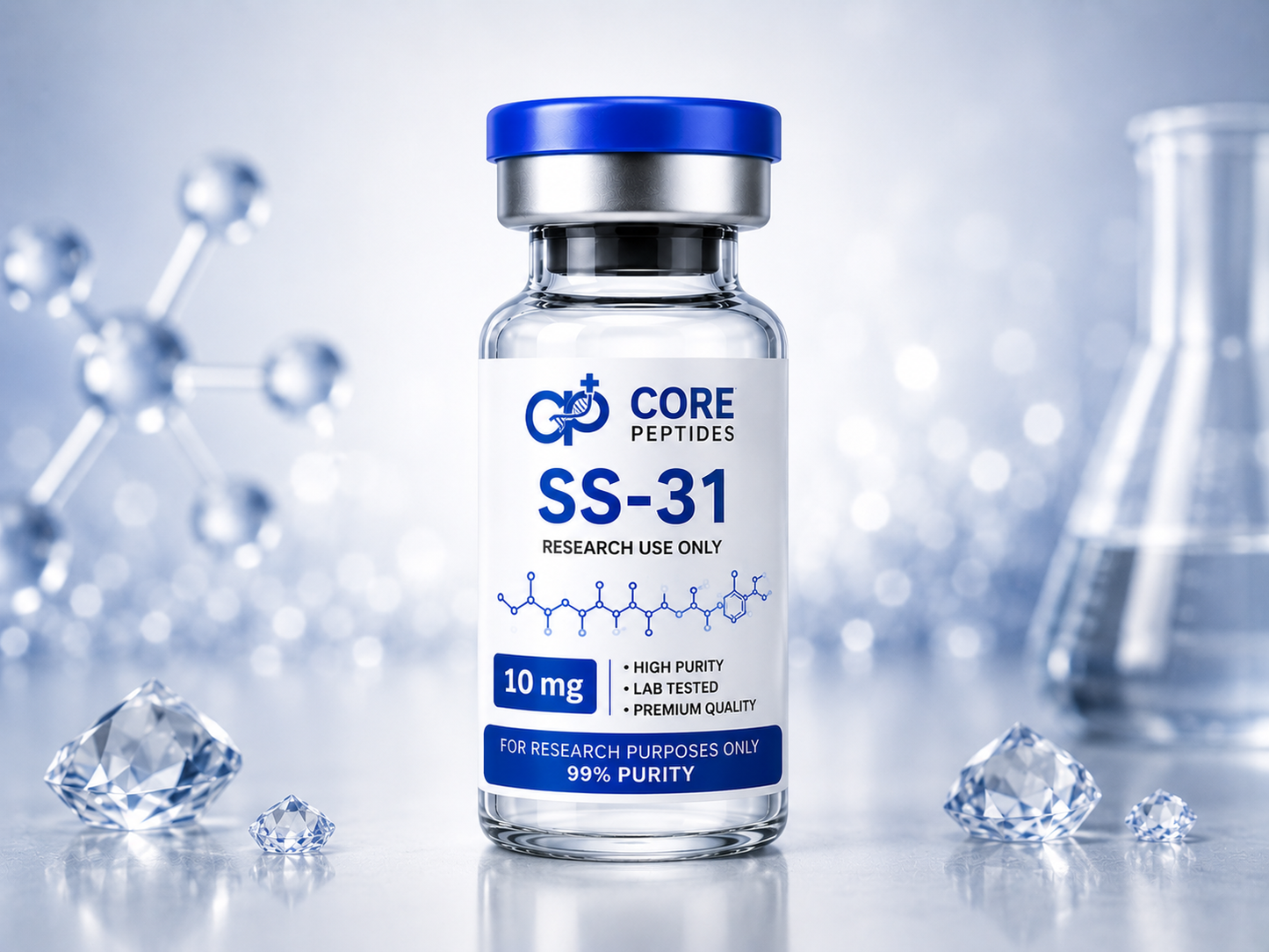
CorePeptides India supplies SS‑31 synonymous with Elamipretide, MTP‑131 as 10 mg of sterile, lyophilized acetate salt in a nitrogen‑purged glass vial. Batch identity is locked. Every shipment includes a fully traceable Certificate of Analysis covering HPLC purity, mass confirmation, and residual solvent profile.
Product Specifications
| Specification | Detail |
|---|---|
| Product Class / Category | Mitochondria‑Targeted Szeto‑Schiller Tetrapeptide |
| Research Identifier | SS‑31 (Elamipretide, MTP‑131), CAS 736992‑21‑9 |
| Supplier / Brand | CorePeptides India |
| HPLC Purity Threshold | >99% (RP‑HPLC, C18, 214 nm, batch‑specific) |
| Target Receptors / Chemical Pathways | Cardiolipin (inner mitochondrial membrane) in‑vitro high‑affinity binding reduces cytochrome c peroxidase activity, inhibits permeability transition pore opening, and attenuates reactive oxygen species generation in isolated mitochondrial preparations |
| Regulatory Status | For In‑Vitro & Laboratory Analytical Research Only. Not for human, veterinary, diagnostic, or therapeutic use. |
Research Overview & Mechanism of Action
SS‑31 is a synthetic, aromatic‑cationic tetrapeptide. The exact sequence is H‑D‑Arg‑Dmt‑Lys‑Phe‑NH₂, where Dmt stands for 2′,6′‑dimethyl‑L‑tyrosine. Molecular weight is 639.8 g/mol (free base). The alternating pattern of basic and aromatic residues gives it a unique ability to cross‑lipid bilayers and accumulate several‑hundred‑fold inside mitochondria without a targeting sequence. That property alone makes it a valuable tool for inner‑mitochondrial‑membrane pharmacology.
Its binding partner is cardiolipin, a phospholipid exclusive to the inner membrane. In oxidatively‑stressed mitochondrial preparations, cardiolipin peroxidation converts cytochrome c into a potent peroxidase that propagates further lipid damage. SS‑31 docks electrostatically onto cardiolipin, shifts the cytochrome c‑cardiolipin complex from a peroxidase‑competent conformation to a protective one, and restores crista architecture visible under electron microscopy. Researchers use the peptide in isolated mitochondrial respiration assays, ROS‑flux measurements, and cell‑based apoptosis models where mitochondrial membrane potential is the primary readout. Molar ratio dictates efficacy binding saturates at roughly 1:100 (peptide:cardiolipin), so precise analytical concentration control is essential when scaling from cuvette‑based assays to 96‑well cell plates.
Handling, Reconstitution & Storage Protocol
Store the unopened vial at –20 °C. Short‑term transport at ambient temperature (up to 5 days) does not impair peptide integrity in our stability programme. Let the sealed vial sit at room temperature for 15‑20 minutes before opening this prevents condensation from pulling moisture into the lyophilized matrix.
Reconstitution for analytical research:
- Use sterile phosphate‑buffered saline (PBS, pH 7.4) or sterile water for injection.
- For a 1 mg/mL stock, add 10 mL of diluent. Inject slowly against the inner glass wall. Swirl gently. The peptide dissolves quickly and completely. Do not vortex the amphiphilic character of SS‑31 promotes foaming and interfacial aggregation.
- For low‑micromolar working solutions in plastic cell‑culture plates, pre‑coat pipette tips and microcentrifuge tubes with 0.01% BSA solution for 10 minutes before transferring the peptide. Including 0.05% BSA in the assay buffer helps maintain the free‑peptide molar ratio during extended incubations.
Post‑reconstitution storage: keep the solution at 2–8 °C and use within 2‑3 weeks. Single‑use aliquots are strongly advised. Each freeze‑thaw cycle drops detectable cytoprotective signal by roughly 10‑15% in our in‑house cytochrome c oxidation assay. Aliquot volumes according to your planned replicates, not leftover convenience.
Scientific References & External Citations
- PubMed: SS‑31 / Elamipretide Mitochondrial Research Peer‑reviewed in‑vitro and ex‑vivo studies mapping cardiolipin binding, ROS attenuation, and mitochondrial bioenergetics.
- PubChem Compound: SS‑31 (CID 11765620) Structural identifiers, molecular formula, and chemical properties of Elamipretide.
- ClinicalTrials.gov: Elamipretide Investigator‑Led Protocols Registered clinical research protocols studying mitochondrial‑targeted peptide pharmacology.
Frequently Asked Research Questions
What is the exact sequence and molecular weight of SS‑31?
CorePeptides India supplies SS‑31 as the acetate salt of H‑D‑Arg‑Dmt‑Lys‑Phe‑NH₂. Dmt is 2′,6′‑dimethyl‑L‑tyrosine. The free base monoisotopic mass is 639.8 g/mol. This identity is verified by ESI‑MS on every batch‑specific Certificate of Analysis.
How should SS‑31 be reconstituted for isolated mitochondrial assays?
Prepare a 1 mg/mL stock in sterile PBS, pH 7.4. Let the lyophilized powder reach room temperature before opening. Swirl gently vortexing is unnecessary and promotes aggregation. For working concentrations under 10 µM, include 0.05% BSA in the buffer and pre‑block all plasticware to minimise adsorptive loss of the amphiphilic peptide.
Is a batch‑matched Certificate of Analysis provided with every order?
Yes. Each 10 mg vial from CorePeptides India includes a printed and digitally archived COA with the RP‑HPLC purity reading, retention time, ESI‑MS mass spectrum, and residual solvent analysis. The lot number on the vial links one‑to‑one with that COA.
Can SS‑31 be used in human clinical or therapeutic development?
No. SS‑31 is manufactured strictly for in‑vitro laboratory research. It is not authorised for human or veterinary administration, diagnostic procedures, or therapeutic application. All purchase orders are reviewed to enforce this restriction.